Republished from Givving, where it first appeared on 27 November 2024 and was updated on 10 June 2025. Givving is the AI gift recommendation product our founders designed, built and took to market. The framework below is the research behind its engine.
Abstract
Gift-giving is a universal human custom that predates written human history. Archaeological and anthropological research confirms its presence from prehistoric times, possibly even predating modern humans. The practice of giving gifts is deeply embedded in the fabric of social, spiritual and cultural life across civilisations.
Gift-giving in modern western society has become intimately intertwined with consumerism and material exchange. Whilst important for social bonding, trust, and relationships, the custom has become overly commercialised, resulting in billions of dollars of unwanted gifts and millions of tonnes of landfill waste each year.
Gift selection is a complex process. This research investigates the limitations of current search engines and gift recommendation systems, which often rely on simplistic heuristics and fail to capture the nuanced interplay of individual preferences, contextual factors, and the emotional impact of gift-giving.
We propose a novel framework that integrates advanced artificial intelligence (AI) methodologies with a sophisticated probabilistic approach to address these shortcomings.
By leveraging large language models (LLMs) for natural language understanding, neural networks for predictive modelling, and sophisticated search engine analysis for real-time trend identification, the framework provides personalised gift recommendations tailored to individual users, their relationships, and the specific context of the gift-giving occasion.
A key innovation lies in the adaptation of the Drake Equation, a concept from astrophysics, to develop a "Gift Relevance Score" that quantifies the suitability of each recommendation across multiple dimensions, ensuring a more nuanced and insightful approach to gift selection.
Preliminary deployment of this framework in the Australasian market demonstrated a twofold increase in user engagement time and session frequency compared to industry averages, showcasing its potential to redefine the gift recommendation experience.
Introduction
The origins of gift-giving have been traced to our evolutionary history. Gift-giving is a means for building trust, reinforcing kinship, and ensuring mutual survival. Across time, geography and cultures we observe a common set of social obligations. to give, to receive, and to repay. This practice involves a delicate balance of expectations and obligations, many of which remain unsaid in modern society. Gift-giving has been shown to have legal, economic, moral, religious and aesthetic dimensions. As a practice it contributes to the creation of enduring social bonds, reinforces alliances and impacts social hierarchies. As such, choosing gifts well is an essential skill.
Whilst many people identify as being competent or skilled gift givers, we can clearly see that gift-giving en masse is highly ineffective. Research shows that Americans spend around USD $10.1 billion annually on unwanted holiday gifts, with 61% of surveyed people saying they receive at least one unwanted gift each year, creating an estimated 5 billion pounds of waste. In our local economy, Australians spend over AUD $900M on unwanted and unused gifts, resulting in an estimated 275,000 tonnes of gift waste.
We assert that the root cause of ineffective gift-giving is information asymmetry between the gift buyer and gift recipient. Gift buyers often lack the information necessary to choose a gift that the recipient will value, and the social framework for what is commonly expected and acceptable in the gift-giving process prevents the parties exchanging this information directly. The fast growth of the gift card market demonstrates this asymmetry. it’s easier for gift buyers to shift the onus of choosing a gift on to the recipient to circumvent their lack of information, however, gift cards do not fulfil many of the key unspoken obligations of the gift-giving process, namely the ‘thoughtfulness’ and ‘novelty’ that most people expect.
Challenge
There is a strong and urgent need for better gift selection solutions that are ubiquitous and easily accessible. Finding and choosing a gift that a recipient will value presents significant challenges:
Information Asymmetry: Gift buyers frequently lack the information required to choose a gift that the intended recipient will value. A lack of communication in the process can contribute to fulfilling many social expectations (including surprise, novelty, thoughtfulness, etc.) but also leads to a gift giver having to guess what the recipient will value.
Subjectivity of Preferences: Individual tastes and desires are highly subjective, temporal, and vary significantly across individuals and contexts.
Contextual Nuances: The appropriateness of a gift is heavily influenced by the occasion (birthday, wedding, holiday), the nature of the relationship between the giver and recipient, and prevailing cultural norms.
Choice Paralysis: The contemporary marketplace offers an overwhelming array of options.
Incomplete Solutions: Common solutions do not solve the core challenges in a way that fulfils the social obligations of gift-giving. Rather, popular solutions simply shift the obligation of choice back to the recipient. gift cards, wish lists, and cash are all examples of this shift in obligation.
This research addresses these limitations by proposing a novel framework that integrates: Advanced AI Methodologies.
Large Language Models (LLMs): To interpret user inputs, understand the nuances of their requests, and extract key preferences, emotional cues, and contextual information.
Neural Networks: To analyse user data, predict future preferences, and identify potential gift categories and specific products based on historical patterns and emerging trends.
Search Engine Analysis: To identify trending products, cultural shifts, and emerging gift ideas by leveraging advanced search techniques and real-time data streams. Adaptation of the Drake Equation.
A concept from astrophysics, the Drake Equation provides a framework for combining multiple probabilities into a single, meaningful value. We adapt this framework to develop a "Gift Relevance Score" that quantifies the suitability of each recommendation across multiple dimensions, including personal compatibility, contextual relevance, emotional impact, and practical considerations.
Framework
The proposed framework operates through a multi-stage process:
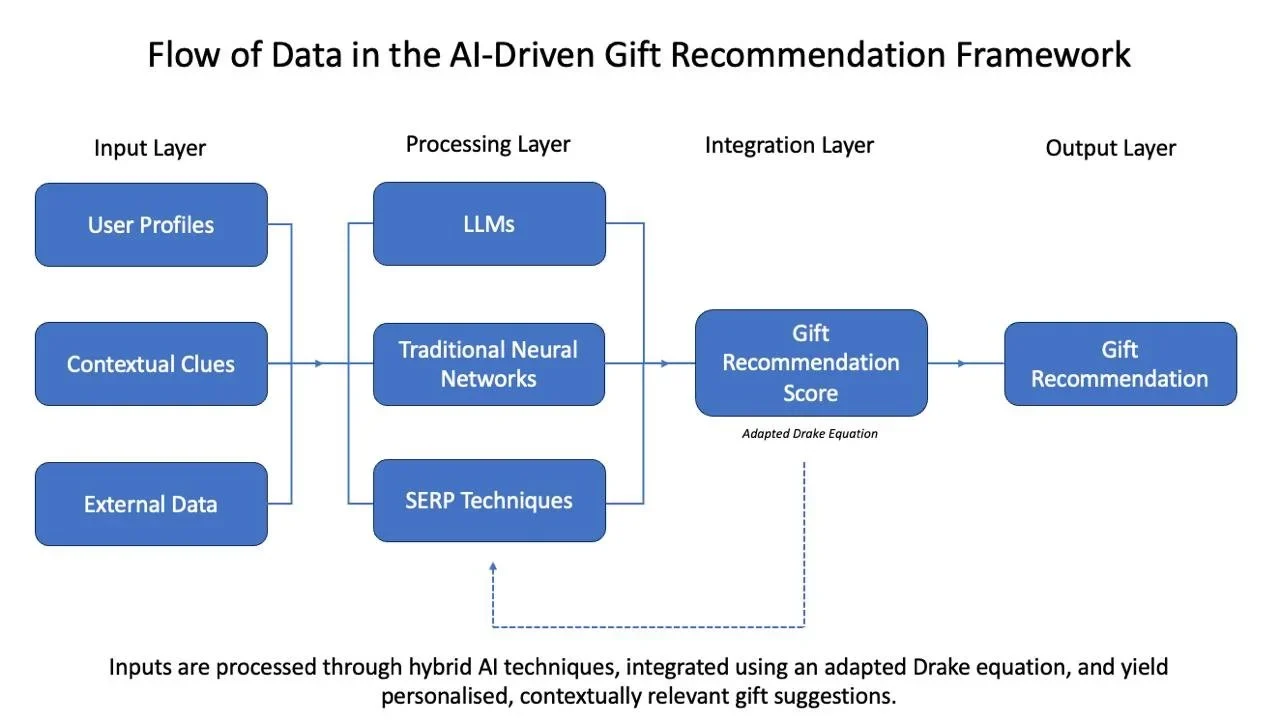
Input Layer: Gathering comprehensive data from various sources, including:
User Profiles: Demographic, psychographic, preference and other related data.
Relationship Data: Relationship type, occasion, and inferred emotional context (e.g., level of intimacy, formality).
External Data: Real-time trends, product information, cultural insights extracted from search engine results, and sentiment analysis of online reviews. Processing Layer.
LLM-Powered Natural Language Understanding: Utilising LLMs to interpret user inputs, understand the nuances of their requests, and extract key preferences, emotional cues, and contextual information. For example, an LLM can analyse a user's request like "find a unique and thoughtful gift for my best friend's 30th birthday" to extract key keywords (unique, thoughtful, best friend, 30th birthday) and infer emotional cues (affection, friendship).
Neural Network-Based Predictive Modelling: Employing neural networks to analyse user data, predict future preferences, and identify potential gift categories and specific products based on historical patterns and emerging trends. Neural networks can identify patterns in user behaviour, such as preferred brands, product categories, and price ranges.
Search Engine Analysis: Leveraging advanced search techniques, such as semantic search and sentiment analysis, to identify trending products, cultural shifts, and emerging gift ideas. This includes analysing search query data, social media trends, and online reviews to identify popular and culturally relevant gifts.
Integration Layer: Probabilistic Scoring
Applying the adapted Drake Equation to calculate a "Gift Relevance Score" for each potential gift. This score considers multiple factors, including:
Personal Compatibility: Alignment with the recipient's interests, preferences, and personality, as determined through user profile analysis and LLM-based sentiment analysis.
Contextual Relevance: Appropriateness of the gift for the specific occasion, relationship, and cultural context.
Emotional Impact: Potential to evoke positive emotions and create a lasting impression, as inferred through sentiment analysis of product reviews and LLM-based analysis of user input.
Practical Considerations: Factors such as budget constraints, availability, delivery options, and product quality.
Trendiness and Novelty: Reflecting the current popularity and uniqueness of the gift, as determined through search engine analysis and social media trend identification. Personalised Recommendations. Presenting users with a ranked list of gift recommendations, highlighting the most relevant and impactful options based on the calculated scores. The framework can also provide personalised explanations highlighting the key factors that contributed to its recommendation.
The Drake Equation Adaptation
The Drake equation, originally developed to estimate the number of communicative extraterrestrial civilisations, combines unrelated probabilities into a structured prediction. It is said that the usefulness of the Drake equation is not in the solving, but rather in the contemplation of all the various concepts which scientists must incorporate when considering the question of life elsewhere.
We adapt this probabilistic framework to compute a Gift Relevance Score (GRS), quantifying the suitability of a given gift. Each factor in the equation contributes uniquely, allowing for a comprehensive and tailored evaluation of gift options. For example, the weighting of individual factors such as ‘Timeliness’ or ‘Emotional Impact’ can be adjusted dynamically to reflect varying user priorities or specific contexts, ensuring the recommendation aligns closely with the intended purpose.
This approach mirrors the original intent of the Drake equation: to provide structured predictions in complex, multifactorial scenarios.
NB: Each factor is normalised, weighted, and based on the individual (x).
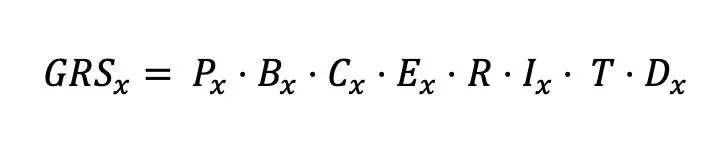
Where. P: Personal Compatibility. Alignment with the recipient's interests, preferences, and personality, as determined through user profile analysis and LLM-based sentiment analysis.
B: Budget.
C: Contextual Relevance. Appropriateness of the gift for the specific occasion, relationship, and cultural context.
E: Emotional Impact. Potential to evoke positive emotions and create a lasting impression, as inferred through sentiment analysis of product reviews and LLM-based analysis of user input.
R: Trends. Reflecting real-time popularity based on SERP insights.
I: Intrinsic Value. Combining the practical and perceived worth of the gift.
T: Timeliness. Considering delivery feasibility within required timeframes.
D: Discovery/Novelty. Reflecting the current popularity and uniqueness of the gift, as determined through search engine analysis and social media trend identification.
Alpha Results
An “alpha” version of the framework was deployed as a web application targeting the New Zealand and Australian markets (try.givving.co). Key performance metrics from Google Analytics include:
2x engagement compared to the global category average for shopping apps.
3:38 minutes average engagement time per session.
2.86 sessions per user, indicating repeated interaction.
These results demonstrate the system’s potential to enhance user satisfaction through thoughtful and relevant recommendations.
Conclusion
This whitepaper presents a novel framework for personalised gift recommendations that integrates advanced AI methodologies with a sophisticated probabilistic approach.
By leveraging the power of LLMs, neural networks, and advanced search engine analysis, this framework addresses the limitations of existing gift-giving solutions by providing more personalised, contextually relevant, and emotionally resonant gift suggestions.
An adaptation of the Drake Equation provides a robust and nuanced approach to quantifying the suitability of each recommendation, ensuring that the final recommendations are both insightful and helpful for users.
This framework has the potential to significantly improve the gift-giving experience for givers and recipients, making it more efficient, enjoyable, and meaningful. By addressing the limitations of current solutions and leveraging the power of AI and a novel probabilistic approach, this framework can help individuals navigate the complexities of gift-giving in a way that better fulfils fundamental social expectations, resulting in more gifts that recipients truly value, thus leading to less unwanted and unused gifts and therefore less unnecessary expenditure and gift waste.
References
Gbor, N. Walters, B. The Australia Institute. (2023). Christmas waste polling 2023.
Mauss, Marcel. Presses Universitaires de France. (1954). The Gift. The Form And Reason For Exchange In Archaic Societies.
Farrelly, Daniel. University of Worcester. (Unknown). The Psychology Of Giving Gifts.
Sweeney, Erica. Discovermagazine.com. (2021). How Holiday Gift Waste Impacts The Environment.
Brown, T., et al. (2020). Language Models Are Few-Shot Learners. OpenAI.
LeCun, Y., Bengio, Y., & Hinton, G. (2015). Deep Learning. Nature, 521(7553), 436-444.
Goodfellow, I., Bengio, Y., & Courville, A. (2016). Deep Learning. MIT Press.
Russell, S., & Norvig, P. (2020). Artificial Intelligence: A Modern Approach (4th ed.). Pearson.
Ha, D., & Schmidhuber, J. (2018). Recurrent World Models Facilitate Policy Evolution. Advances in Neural Information Processing Systems.
Blei, D. M., Ng, A. Y., & Jordan, M. I. (2003). Latent Dirichlet Allocation. Journal of Machine Learning Research.
Konesky, Gregory. Harvard University. (2009). The Drake Equation Revisited.
A East, J Smith (2024). The Future of E-commerce: AI's Role in Customer Experience Optimization.
Tarvainen, J., & Valpola, H. (2017). Mean Teachers Are Better Role Models: Weight-Averaged Consistency Targets Improve Semi-Supervised Deep Learning Results. Advances in Neural Information Processing Systems.